
How to: Incorporate effective e-learning into your safety training program

Modern technology continues to offer new ways for businesses to meet their workforce training needs. Electronic learning (e-learning) can pay a vital role to maximise the efficiency and effectiveness of workplace health and safety training programs thus helping to do more with less.
Health and safety laws require that employers provide necessary information, training, instruction or supervision needed to protect everyone in the workplace from risks to their health and safety.
The form this information, training or instruction takes varies depending on the risk profile of the work being performed, the number of workers and the training methods available. E-learning – the delivery of an education program by electronic means – can be part of the solution. It has a number of potential benefits, including:More cost-effective when training a large number of workers;
Reducing volume of face-to-face training required;
Can assess trainees’ competence and capture evidence of training completion; and
Enables video, avatars and other visually enticing material to be included to make the training interactive and interesting, compared to traditional safety training.
Note that the e-learning industry is highly competitive and innovative, so it is worth shopping around for quality products.
Some organisations treat e-learning as a magic bullet for their health and safety training needs. However, the reality is that it is just one piece of the puzzle.
So, how can e-learning best fit into your overall training program? The following steps will help you determine this.
STEP 1: Define your training needs
Training can be summarised into the below categories.
Qualifications: Training designed to meet a set of predetermined criteria that qualify someone to be eligible for a duty, office, position, privilege or status (e.g. Certificate IV in occupational health and safety).
E-learning - can form part of obtaining a qualification, but the material must satisfy the learning requirements. This type of training is often delivered through Registered Training Organisations (RTOs) who develop the required materials and trained facilitators.
Licences: These are a form of qualification, usually consisting of a specific permit from an authority to own or use something, do a particular task, or carry on a trade, e.g., a forklift licence.
E-learning - can help trainees to obtain a licence, it is usually managed through RTOs, and visual observation is usually required to assess competence.
Competency: This is more generic, and describes a cluster of related abilities, commitments, knowledge and skills that enable a person to act effectively in a job or situation. A competency is more related to specific work tasks, e.g. demonstrating competency in using a forklift in a specific environment.
E-learning - can play a significant role in delivering this type of training to your workforce.
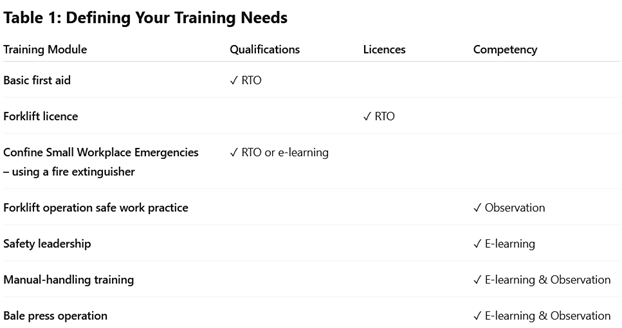
Once you know which types of training you need, you can begin to determine where e-learning could be integrated into the program, as shown in Table 1.
STEP 2: Decide whether to deliver e-learning in-house or to use an external provider
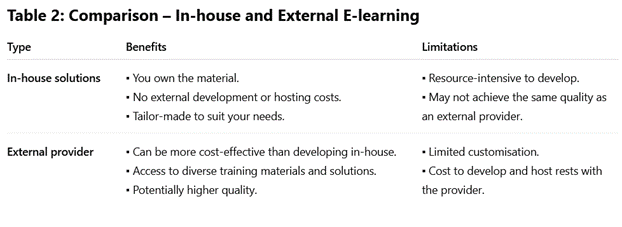
There are both benefits and limitations to developing e-learning solutions in-house and using an external provider, as shown in table 2.
STEP 3: Decide on the course content
Next, you must determine what knowledge and skills the course should impart – this is especially important if you are designing in-house solutions.
It is recommended persons developing course content should have applicable qualifications (e.g., Certificate IV in Training and Assessment), and be able to apply learning principles to create an appropriate program structure. External providers should have training personnel to assist with this process.
Once the course’s learning outcomes have been decided on, the content can be developed and e-learning resources incorporated if appropriate.
E-learning can use a variety of types of content, including video, animations, images and text. As an example, take a look at these screenshots from an e-learning course called “Responding to Workplace Emergencies”, which was designed to train Target Australia’s Fire Wardens.
4. Obtain feedback
After your training has taken place, obtain feedback from participants so that the program can be reviewed and the content can be further improved.